Mom's Gyaan
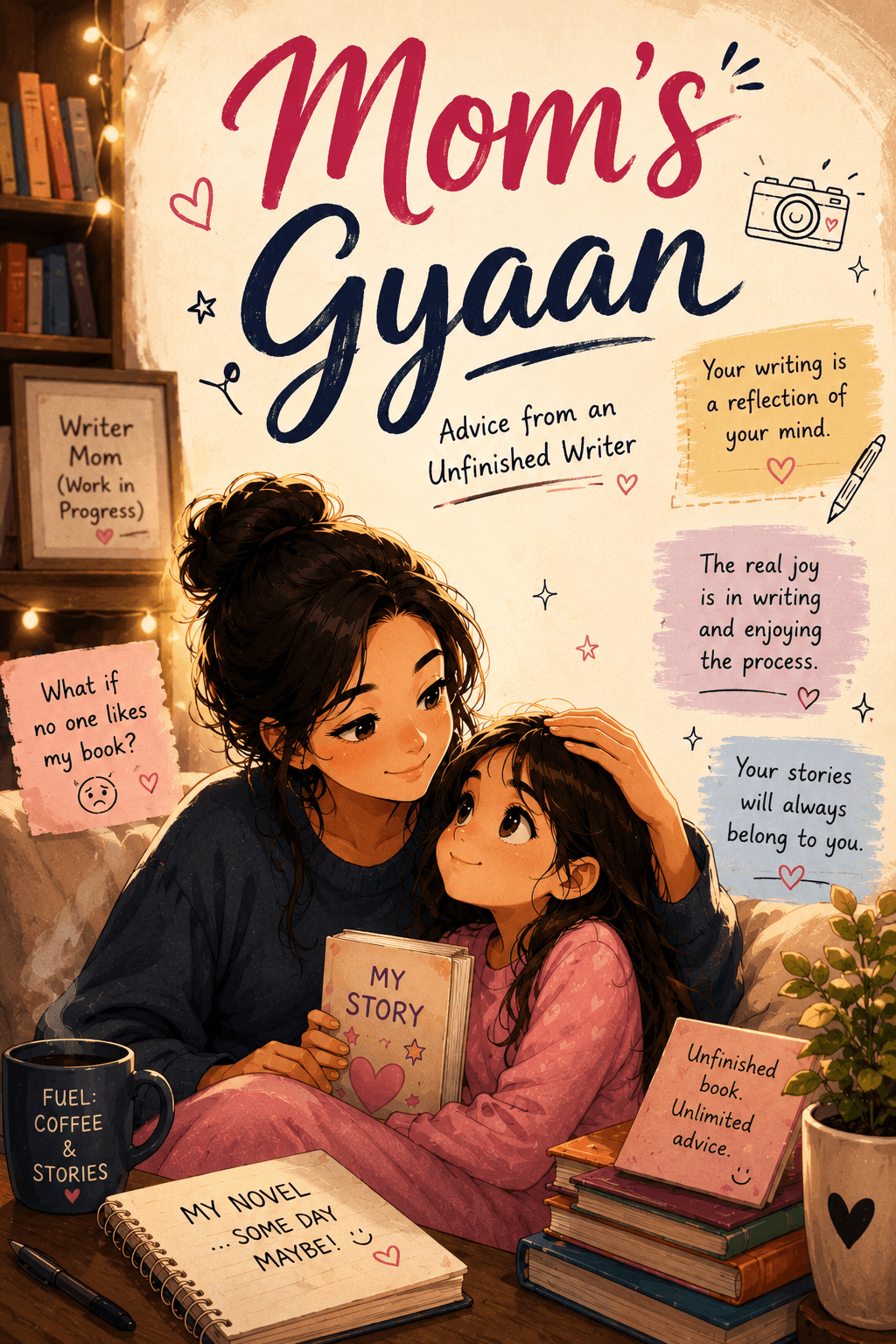
One day, my daughter came to me while I was lying on the sofa after a long day of working and reading my novel. I had my novel held up in front of my face, thinking that maybe, just maybe, everyone would take the hint and leave me alone. But then she called, “Mom.”
The sound of her voice felt a little heavy and composed, very different from her usual playful “Mamma, mamma,” which could make me drop whatever I was doing and give her my full attention.
I looked at her. There was no sign of her usual mischievousness. Normally, she is a child who seems to have an unlimited supply of energy and absolutely no agreement with the concept of sitting still. But that day, she stood there unusually calm and composed.
Instinctively, I knew something was on her mind.
I tried not to look worried. “What is it?” I asked gently.
There was worry in her eyes. She stayed quiet for a few seconds before finally saying, “What if no one likes my book?”
I almost laughed—not because her worry was funny, but because the relief I felt was enormous. My mind had already prepared itself for something much more serious.
“Oh,” I thought. “So this is about book reviews. We can handle this.”
My daughter has written an amazing story, one that we loved so much that we decided to publish it as a full-fledged book and make it available to the public. Naturally, now that her little creation was about to meet the big, opinionated world, she had begun to worry about what people might think.
And then came my next problem.
What exactly was I supposed to tell her?
I had never been in her position. My own book had never been published. In fact, if we are being completely honest, I have never even managed to finish writing one.
So here I was—a mother still negotiating with her own unfinished novel—about to give life advice to an actual published author.
Clearly, I was qualified.
I asked her to sit beside me. I cuddled her and ran my fingers through her hair, secretly buying myself a few seconds to come up with something wise.
Then I said, “When you look into the mirror, you admire yourself, don’t you?”
She looked at me suspiciously.
“Yes,” she said. “But how is that relevant?”
Fair question.
My daughter loves looking at her reflection, even when she is upset. So I continued.
“Your writing is a reflection of your mind. You write different stories when you are in different moods, and those feelings find their way into your writing. Every blank page captures a little moment of your thoughts, almost like a photograph.”
She listened quietly.
“So,” I continued, “does it really matter whether everyone likes it or not? Your story is a reflection of you. Other people may love it, dislike it, misunderstand it, or completely ignore it. But none of that changes what it means to you.”
I paused, feeling rather philosophical.
Honestly, I was beginning to impress myself.
I went on.
“Publishing a book, getting reviews, seeing people praise it—those things are secondary. They are things we created to measure success. The real joy is in writing. It is in pouring your thoughts onto paper and then, years later, reading them again and remembering exactly who you were when you wrote them.
“Your stories will become like a photo album. Each one will remind you of a particular version of yourself. Some will make you laugh. Some might make you cringe. And some might make you wonder, ‘What on earth was I thinking?’ But they will all belong to you.”
She smiled.
I could see the worry slowly leaving her face.
For a moment, I felt like I had delivered the perfect motherly speech. Somewhere inside me, a tiny voice whispered, Maybe I should finally finish my own novel. Apparently, I know what I’m talking about.
She hugged me, which was completely typical of her.
But then she held my hand and said something that made tears roll down my cheeks.
“Mom, I’m really free now about what will happen with my stories. But I promise you, I will never stop writing them.”
And just like that, my little girl taught me something far greater than anything I had tried to teach her.
Maybe being a writer isn’t about making everyone love your stories.
Maybe it is simply about having stories inside you—and refusing to let them stay there.
And perhaps, unlike my own novel, hers will actually make it to the end.